
Judy asked: How do I clean up melted, cheap aluminum paper? I have a brand new stove, and like an idiot, I placed a sheet of aluminum paper on the bottom oven pan (for drips). It was directly over the heating unit, and after using the oven a few times, the aluminum was completely melted on. I have tried everything to remove it, and over the past three days, have gotten off about 75% of the mess! I can’t clean the rest! Any help would be appreciated as this oven is brand new!
People have been lining their ovens with aluminum foil to protect it from drips for decades, but the very trick once used to protect an old oven can destroy a new one in just minutes. New ovens have the heating element below the bottom liner, which makes the bottom of the oven get almost as hot as the heating element itself. It may seem impossible to remove, but thanks to our many wonderful site readers who have encountered this problem, we know of three methods that can remove the foil.
The Oven Cleaner Method
Many oven cleaner labels, such as Easy Off, warn not to use it on aluminum because it will eat the aluminum. In this case, that’s exactly what we want to happen.
You Will Need:
- Oven cleaner (sodium hydroxide-based solution)
Steps:
- Let the oven cool completely.
- Carefully scrape off as much foil as possible with a razor blade.
- Ventilate the area.
- Spray the oven cleaner on the spots.
- Leave the cleaner on the spots for about 20 minutes, then wipe the area clean.
- Repeat the process as many times as necessary to remove the foil.
- Wash the area to remove any remaining residue from the oven cleaner.
The Naval Jelly Method
Dozens of site users have written in to say that they have successfully used Naval Jelly to remove the foil residue. However, many have also said that the Naval Jelly left some shiny or dark spots in place of the foil. Some people believe these spots are due to the Teflon that’s in non-stick aluminum foil. This doesn’t always happen, and to those it does, they usually say the spots are barely noticeable. Another commenter (Thanks Tess!) says that Naval Jelly can “remove bluing from steel” and should therefore not be used on blue oven interiors. (Many thanks to BK who originally suggested this method!)
You Will Need:
- Naval Jelly Rust Dissolver (available at a hardware store)
Steps:
- Let the oven cool completely.
- Carefully scrape off as much foil as possible with a razor blade.
- Ventilate the area well.
- Put on gloves.
- Apply a thick layer of the Naval Jelly on the foil spots.
- Leave the jelly on the foil for 24 hours. One site user (Thanks Chan!) recommends leaving the oven door open and turning on the range fan or ventilating the area.
- Wipe the area clean.
- If needed, use a razor blade to remove more pieces of foil that have been loosened by the jelly. Instead of using a razor blade, you may be able to use a piece of tape to pull off the foil.
- Repeat the process as many times as necessary to remove all the foil. It may take two or more attempts to get it all.
- Wash the area to remove any residue from the jelly.
The Steam Method
This method has only been reported by one site user (Thanks J.B.L.!), but since it’s an all-natural method and they had success with it, we wanted to include it. As a warning though, do not use plain vinegar without neutralizing it with baking soda. Several others have done that (tried to use only vinegar, not steam) and said that the fumes from the pure vinegar lead to corrosion in other parts of the oven, such as on the racks or fan. Baking soda is a base and will neutralize the acid in the vinegar.
You Will Need:
- White vinegar
- Baking soda
- A towel
- Water
Steps to Remove the Foil:
- Put some baking soda in a bowl, then pour in a little white vinegar. The mixture will fizz and foam up; that is the reaction of the acid and base neutralizing each other. Add a very small amount of vinegar at a time and stir it in thoroughly with the baking soda, then continue adding more until you make a thick paste that is about the consistency of peanut butter or toothpaste, not soup.
- Spread the paste over the foil and leave it on overnight.
- The next morning, wipe off the paste. It may have dried out.
- Soak a towel with water. (Be sure to use a cotton towel, not a synthetic fiber like polyester or rayon which is more susceptible to heat.) Make sure the towel has enough water on it that it will not dry out and catch fire.
- Fold the towel and lay it over the foil area.
- Turn on the oven at 200 degrees F, close the door, and wait 30 minutes. The water on the towel will turn to steam that will cause the foil to release from the oven floor.
- Wait for the oven to cool, then carefully peel off the pieces of foil.
Additional Tips and Advice
- Many site users have also recommended using The Works Toilet Bowl Cleaner instead of Naval Jelly as it works much faster. However, they also say that you must wear gloves and that the fumes are intense. Also, this tip may no longer be useful; as of 2017, The Works has decreased the amount of hydrogen chloride (it’s active ingredient) from 20% to 9.5%, so people who had success with this product in the past may have been using the stronger version.
- Several people have had success using Drano crystals. The Drano crystals work for the same reason as The Oven Cleaner Method – they both contain lye (sodium hydroxide). Read Twizttid’s comment (Thanks!) to learn more about using Drano crystals.
- If none of the above methods work to remove the foil, the bottom plate of the oven can sometimes be replaced relatively cheaply, usually for less than $100.00. Contact your manufacturer for a replacement part and guidance on installing it. This is only true if the bottom plate is a separate part (as opposed to the entire interior of the oven being all one piece).
- If you are worried about food dripping and burning on the bottom of the oven, there are oven liners available that will not melt under the heat. UPDATE: Maybe not… Joy, who posted a comment below (Thanks!) reports that her melted mess is a result of these very liners.
- A cookie sheet can also be placed on a lower rack to catch any drips or spills. Do NOT put the cookie sheet on the base of the oven though or you will end up with a similar problem.
- If you have melted foil in the oven, do NOT run the self cleaning cycle on the oven. One site user reported that doing so baked the foil on worse, making it more difficult to remove, and another mentioned that the fumes are intense/horrible and likely a health-hazard. According to The Aluminum Association, in the high temperature of a self-clean cycle, the aluminum could also cause an explosion.


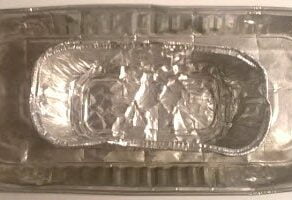




To all those who think this problem description couldn’t be true, you’re wrong. You’re right that the aluminum did not get hot enough to melt though. What happens is that the non-stick Teflon coating they put on the aluminum gets too hot and bonds with the oven bottom, like a crazy epoxy!
Furthermore, this isn’t a problem in older, conventional-type ovens… this is more so a problem with ovens that have a hidden bottom element. The bottom element is actually directly below the oven bottom, and lining the oven bottom with foil is basically like putting it directly on the element. And that part gets extremely HOT!!!
Thankfully, I’ve got the solution to this! But it takes some extreme patience, a lot of respect for what you’re working with and some good ventilation.
I went back to my high school chemistry class to get the answer. It’s lye, AKA caustic soda, AKA sodium hydroxide.
I used Drano Kitchen Crystals off the shelf of the grocery store. It’s about 70% lye with some added salts to aid the chemical reaction.
You’ll need some Plasticine, Drano, water, GLOVES!!, a lot of paper towels and wood skewers, and GOOD VENTILATION.
Start the ventilation and open a window or door.
Put on your gloves.
Use the Plasticine to create a dam about .25″-.5″ high around the area in the oven you’re looking to remove the aluminum from. The areas you’re working in should be about 2.5″ in diameter.
Pour some of the Drano into the dam and add enough water to touch all the sides of the dam. If the chemical reaction hasn’t started (should be almost instant), keep adding the Drano bit by bit until it does. The dam contents will start to boil and ammonia fumes and a little hydrogen gas will form, hence the need for some good ventilation!!
Once the reaction is done, poke around with the wood skewer to see if the oven bottom is clear. If you’re satisfied with the results, add some some vinegar to help neutralize the solution a bit, then use the wood skewer to move the Plasticine dam to a dish to be rinsed off ASAP.
Use paper towels to wipe up the mess on the bottom of the oven. See your results! The area of the oven bottom you treated should be free of aluminum and just be discolored instead. Not from the Drano, but from where the Teflon bonded.
Repeat the process until the oven bottom is clean.
To get a ‘feel’ for the chemical reaction and what to expect, experiment first! Take a square of aluminum foil, go to the backyard with the foil shaped into a little bowl, place it on a dish or pan, add some Drano crystals to it then add a little water. Step back from the dish and try not to breath the fumes! The dish will be hot!!
It took me about six hours to clean the bottom of my oven when this happened to me.
Hopefully this helps some other poor unfortunate souls who finds themselves in this situation!
Thanks for the information. I was able to cleanup all aluminum foil and it left some dark colors.
I have lye in my soap-making stock so I used those with some water on the top of it to melt it down. The bottom of the oven is a little bit shallow so it worked okay without creating a dam, etc…
Thank you.
I appreciate the tips.
Searching through various websites, looking for a way to remove the aluminum stuck to the bottom of my new Sears Kenmore self cleaning oven. For years, I have used these same oven liners and have never had a problem.
I noticed that you suggested under “Additional Tips and Advice” that oven liners can be safely used without sticking. I just want to say that it is the oven liner that stuck to the bottom of my oven, not any foil. It just melted in a large circle, leaving a hole in the middle of the liner pan and the liner pan glued into the bottom of my oven. I am attempting to soak a paper towel with ammonia and let it soak for a while and then will try and get it off. But so far nothing has worked.
Did you ever find something that works? I paid a site to tell me what to do and they said to use oven cleaner, even though my manual says not to. It also says don’t use foil, so when have manuals ever known what they’re talking about? ???? I’m going to try that this afternoon.
Joy, I had the same thing just happen to me with an oven liner! Did you have any luck with the ammonia? Mine didn’t melt as much as yours. I think I caught it before too much damage was done. Most of the liner came up in one piece, but I still have about five small pieces of foil that are stuck. It just happened last night so I haven’t had time to try any of the suggestions yet. I am just sick about it. The oven isn’t even a month old! 🙁
And, it doesn’t appear that the bottom plate can be removed on mine as there are no seams.
I also have a month old stove–double oven–that aluminum stuck to the bottom of the top regular oven. The stove is electric. I was told that the two ovens are one unit, which explains why it melted. So I plan to try the naval jelly because it doesn’t seem to cause fumes. I thought that it was just the convection ovens that you couldn’t use aluminum. Anyone else used the naval jelly?
Twizttid- Your suggestion did not help me at all. I’ve tried using the Drano granules and the reaction did happen, but the aluminum is baked into the enamel and it looks like 🙁 .
I’ve done it two times and no change at all.
As an answer to Emerald, above; the ammonia soaked into a paper towel and left in the bottom of the oven does not work either. Neither does S.O.S or anything else. I even tried a plastic scraper. It is now just a part of the enamel. I read over the manufacturers book that came with the oven and tried their suggestion or cleaning method with ammonia, but it does not work for aluminum. My book does say to remove any aluminum liners from the oven bottom or sides when using the self clean feature. I do feel that manufacturers that can’t put in huge letters on the oven and in the front of the book should take some responsibility.
Emerald, you might call the manufacturer and ask them if the bottom of your oven is removable, and also replaceable. I can find two screws in the bottom of my oven. I have a friend who put in built in double ovens in her brand new home and this happened to her. She has decided to just ignore and continue cooking for now. She did run the self cleaning, but it did virtually nothing to remove it. She has it in both of her ovens.
Hi Joy,
Sorry to hear the ammonia did not work. I’m waiting to hear back from the manufacturer with any suggestions. My oven has a steam clean feature, which I ran and then tried to scrape the foil with a plastic scraper, but that didn’t do a thing. I read somewhere that applying a paste using baking soda and letting it sit overnight might work… also soaking with vinegar. I think I’ll try those next, but from everything I’ve been reading, I’m not holding out much hope. I may just have to live with it and at least be grateful that it is not as bad as what some others have experienced… like your poor friend with two ovens!
I totally agree with you that the manufacturers should make the warning not to use foil much more prominent, like a warning sticker right on the oven window. I think many people who have always used liners in the past instinctively put one in a new oven right away because they want to keep it looking new. In my search for solutions, it appears that many new owners have had this horrible experience. What upsets me the most is that I looked in my manual and read the section “using the oven” before I put the liner in and the warning is not there. It’s buried in another section of general warnings, which I stupidly did not read before using the oven. With such severe consequences, that warning needs to be greatly emphasized!
I’ll let you know if I have any luck or if my manufacturer suggests anything new to try. Oh, and there are no screws in my oven, it appears to be one piece so I don’t think replacing the cover is an option. Sounds like it might be for you though! I read somewhere that it only costs about $45 to get the part from Sears. Hope it works out for you!!!
Twizttid,
Thanks for the lye tip. I have successfully removed the aluminum and now there is a stain as you said there would be. Do multiple lye applications eventually remove the stain also or just the aluminum?
I have used lye to remove foil; not only did it not remove the foil, the process blew the element that is underneath and it blew the fuses two times! The reason I think lye did not help me was the fact that I’ve used a self cleaning process before that, which baked the foil even more into the enamel. Beware, as soon as you have a problem (melted foil), use lye ASAP!
I got all that resolved a month later with a company by getting a new liner!
What an ordeal!
So it looks like, after reading all of the comments, it happens in both electric as well as gas ovens. Wow, what a horrible surprise I received after lining the bottom with foil, like I have done for the past 50 years. I feel so terrible. It wasn’t even my stove/oven. It sure spoiled my delicious dinner. I am just sick.
Back in November, I searched for a way to fix our new oven, could find no help, and didn’t know of Twizttid’s method. I think Twizttid’s method will work, but I can offer a gentler, but longer process.
Naval Jelly is pink goop containing phosphoric acid that is used to remove rust from iron or steel, leaving a clean surface that must be painted right away before rust forms again. You are warned not to use Naval Jelly on aluminum because it will dissolve aluminum (slowly).
Well, dissolving aluminum is what we want to do, and Naval Jelly won’t dissolve steel, so at the suggestion of my plumber (an ex-Navy guy), I tried it. It works very slowly, very little ammonia smell, but will take much longer than Twizttid’s Drano. I’ve been at it for a week and I have almost all of the aluminum off, leaving dark discolored enamel. Once I have the aluminum off, I will let my wife run the self-cleaning cycle. It looks much better, should be safe with self clean, but will not look like new. I may try to buff off the discolored enamel (any advice?).
My method:
Pour small gob of jelly onto the aluminum.
Spread it over the aluminum with a Q-tip.
Smear around the jelly every hour or two when you think about it. I’ve left it on overnight, no problem.
Wipe off the jelly, wipe with a wet paper towel, then towel dry.
Use masking tape to “pluck” the aluminum (the jelly apparently penetrates under the aluminum and loosens it).
Reapply the jelly and start over.
This takes days, but is gentle, with no fumes. The only time you can smell ammonia is when your head is in the oven. My wife has not smelled ammonia yet.
Good luck.
The hardware store to me DO NOT use Naval Jelly as it is TOXIC and a carcinogen. It is a contaminate and any food cooked in that oven should not be eaten. I went to buy it and will try something else. I cannot use lye due to lung issues. I have a repair man scheduled for Wednesday morning.
I’m curious about what your repairman said. I tried Naval Jelly, but it looks like it actually took the coating off of the bottom of the oven. Luckily, we tried it in a small area, but my husband is concerned about that area rusting. I’m worried we may just have to replace the entire oven.
Any update on repairman suggestions? We also tried Naval Jelly (luckily in a small spot) and it looks like it took the coating off of the bottom of the oven. My husband is also concerned about rusting and I can’t replace just the bottom of the oven since it’s all one piece. I’m desperately searching for help that will cost me less than $1000.
Hubby used one of those aluminum oven liners, (like we had previously used for 20 years in our other various ovens). However, our latest oven (Kenmore) has a hidden element and it does say not to use one. I didn’t see him do it. All of a sudden, I hear “Uh-oh.” Needless to say, the middle of the tray fused with the bottom of the oven. Most came off (with scraping – I’m sure the oven enamel is damaged), but there is still some there. Anyone have any solutions (I don’t want something that is toxic and smelly – we have a realtors’ caravan and then an open house coming up!!)
‘BK’, IT WORKED!!! WE CAN’T THANK YOU ENOUGH!
We had an expensive (for us) KitchenAid range, that I waited years for. It was 2 DAYS OLD on Friday, when in order to protect and keep it clean, I put foil on the oven bottom as so many others have! Of course, our story is the same, and we were horrified several hours later to see the scraps of foil burnt onto the oven floor after our first baking experience! Our oven interior IS ONE PIECE, and so there is no way to replace damaged sections, even if we could have afforded it, which we could not. This range was delivered last Friday, and this happened Sunday night! My husband tried to scrape it off with a plastic piece, while in shock, I went online to seek help. I read post after post of ‘forget it—no way to remove the foil’, and was ready to break down when I happened upon YOUR post!
As luck would have it, WE HAD NAVAL JELLY IN THE HOUSE, and my husband had come across it only days ago, and put it on our work shelf!
Well, it is now Tuesday, and the FOIL IS GONE, AND OUR OVEN UNDAMAGED!!!!!!! The one thing I would add to your wonderful instructions is to USE THE JELLY GENEROUSLY—COVER EVERY BIT OF FOIL WITH A THICK LAYER OF THE NAVAL JELLY, AND THEN LET IT SIT UNDISTURBED FOR ALL DAY OR ALL NIGHT, AT LEAST. The first night we didn’t put enough on. On Monday AM we put a THICK coating of naval jelly on the foil and within several hours saw more improvement than we had after all night. We put more on on Monday AM, and left it completely alone for 24 hours. Now, on Tuesday AM, our foil mess IS COMPLETELY GONE!!! I can now wipe up all the jelly, and wash the oven interior, and finally USE my brand new oven again!
AGAIN, WE CANNOT THANK YOU ENOUGH FOR YOUR TERRIFIC ADVICE, AND HOPE THAT OTHERS WITH THIS DILEMMA FIND THESE POSTS!
These products also work very well: Lime-A-Way, CLR, The Works.
I have used “The Works,” which is a stronger version of Lime-A-Way, CLR, and similar products, for removing rust. When the above post mentioned Naval Jelly, I knew I could use anything which removes rust. “The Works” is a toilet bowl cleaner for mineral deposits and I have used it to remove rust from my car as well. The Works removed the aluminum foil, but a slight discoloration remained, which I would describe its appearance as a spot of much-faded baked-on grease.
A few months have passed since I last left a comment or tried suggestions again to clean up the aluminum liner pan from the bottom of my Kenmore oven. I did try Mariana’s suggestion and bought some pink Naval Jelly. Did this for several weeks, but I might add, not diligently. But I could see a little bit coming off. Finally, tried to put it on as Adam & Mary had suggested, by applying a very thick layer of the pink stuff and then forgetting about it for a couple of days. By the second application, it was all gone. No mess, no smell, no fuss. Yes, there is a discoloration in the bottom, but it does not show like silver aluminum shows. I might add that I did buy new aluminum foil liner pans and put one of the racks on the very bottom rung of the oven. Then, I put the liner pan on top of that rack. I have another rack on top of it to cook on and the third rack is way up on top, leaving me plenty of room. Also, it states right on the aluminum liner, “do not place in the bottom of your oven.” It also suggests putting it on an oven rack on the lowest level of your oven. I have done this. I also line it with an extra piece of aluminum foil so if I have run-overs, I can just change the foil on the pan rather than changing out the whole liner. My oven works perfectly and does not smell. Thank you so much for your suggestions with the Naval Jelly. It worked.
OK, so this also happened to me last weekend, with both my wall ovens, while baking peach pies. I’ve used the naval jelly for five days on one oven. It’s a slow process, but most of the foil is gone, another 2+ days to go… Now, how do I remove the Teflon on the foil, left behind? It looks like a clear liquid has been painted on the bottom of the oven with brush marks, but it’s hard and won’t scrape off. The Naval Jelly hasn’t loosened that at all. How do I get rid of this? I’ve written a complaint letter to Renold’s Foil Co. and I’m about to write another to GE… I wonder if I’ll ever get a reply.
Where did the Teflon come from?
Rira,
The nonstick coating that is put on some aluminum foil products is Teflon. Standard aluminum foil does not have this coating.
Mine did the same thing with the Teflon coating. It looks like a clear resin dried in loops and swirls on the floor of my oven.
I went online and asked GE help with what to do. His suggestion was to use the finest grade sandpaper and use it with water. He said it would take a lot of elbow grease, but should remove the foil and epoxy-type clear residue from the foil, and not harm the enamel coating on the oven floor. At this point, I have nothing to lose.
We personally would advise you to disregard the advice to SAND this off!
We think that guy’s advice is really a bad idea. The ‘discoloration’ left after the Naval Jelly has removed ALL of the foil is permanent. There is no way to remove it as it is actually now a burn mark shadow in the oven floor itself. We weren’t too thrilled to see that on our brand new KitchenAid range after we removed the foil, but honestly, it doesn’t hurt anything, smell, or get worse. It is just what happens when you put foil down in these new ovens. We are just so thankful the Naval Jelly took off all the foil! DO NOT try the sanding. We feel you would definitely make the problem worse and more unsightly!
Kathy:
I am in agreement with Adam & Mary. Go up five messages to Joy and then read my post. After use of Naval Jelly, I am free and clear of the aluminum on the bottom. I do have a shiny-type residue, like you mentioned, on the bottom of my oven. But that residue beats the look of the bright silver aluminum and I can safely run my oven, which I have done at high temps without any burn smell or smoke. The oven has three racks and I put one rack in the very bottom rung of the oven and placed an aluminum liner pan on the top of that rack and then another rack at the height I wanted it. And removed the third rack. The liner pan works perfectly on the top of the rack on the bottom rung and you can’t even see the residue and since it catches any spills, I can change the foil that I put on that aluminum liner and have not had any burn smell or smoke.
Where does one purchase Naval Jelly?
I got my Naval Jelly at a True Value Hardware Store. But probably any hardware store will carry it. You might try Home Depot or Lowes also.
Count me as one of the lucky ones to find this post! On Thursday, I made the fateful decision to bake a pizza in the top oven of my Kenmore Elite Double Oven. This oven was approx $1600 and purchased only six months ago. Of course, not wanting to ruin the bottom of the oven with melted cheese and sauce, I placed Reynolds aluminum foil in the bottom. Approx 10 minutes later, the pizza was burnt to a crisp and the aluminum foil was melted to the bottom of the oven. I then tried the usual route of trying to clean it off by scrubbing and then burning it off at a high temp. Nothing worked. The next day I looked online and found these posts. I purchased my Naval Jelly at True Value Hardware and nervously smeared it all over the bottom of the oven and let it sit for 24 HOURS. After the first day, I took a scraper and carefully and lightly scraped the aluminum. I could immediately tell that it was working, as I saw aluminum pieces in the pink jelly. I then left it on for another 24 HOURS and then again scraped it. I then wiped up all the jelly and neutralized the oven bottom with baking soda. I would say that 98% of the aluminum was eaten up. There is a small amount of residue on the bottom, but I may try it again to see if I can remove that. This residue is some dark discoloration and a little bit of glazing. This is way better then melted aluminum though! Thank you again for all your info; you all have saved the day! P.S. if any one has any ideas to remove the discoloration and glazing, let me know.
A little over a month ago, I used a cheap foil on the bottom of my brand new expensive Electrolux oven. I called the company the next day. They raised my hopes by telling me it would come off by soaking Dawn Dish Detergent on it and scraping off with a razor blade. I have been soaking for a month and scraped twice. Sadly, I’ve gotten some off, but a lot seems to be fused right on the liner. 🙁 I think I will try the Naval Jelly today. Do you think generic brand foil makes this problem worse?
Although it took me four applications, the bottom of my oven is now foil-free!! Thank you so much for recommending Naval Jelly (in the paint dept. at Lowes) as the solution to my dilemma!
Sure wish someone would label the new ovens with this warning!!
Will the Naval Jelly remove baked-on non-stick oven liner?
I recently did the obvious as well, this morning as a matter of fact; sigh. The foil is baked onto the bottom of my three-month-old convection oven.
But, I remembered when my husband and I made a pan of ribs a few years back and marinated them overnight in a large thick aluminum pan with a thinner aluminum covering the top of the BBQ sauce-coated ribs. The next day, I noticed there were small holes in the aluminum foil covering the ribs. I was also concerned the pan was leaking. Needless to say, the thicker aluminum was OK, but I researched why the thinner aluminum would dissolve.
Turns out that the salt and vinegar from the BBQ sauce touching the aluminum caused a reaction which dissolves the aluminum, and fortunately, the byproduct is an aluminum salt, which was safe to consume, or my pan of ribs would have been trashed.
Currently, the vinegar and salt solution is soaking the bottom pan of the oven. I’m going to leave it overnight. I will keep you posted of the progress. I hope it works the same way it did for the foil on my ribs!!
Wish me luck!
Update:
Well, I initially had applied the salt and vinegar solution in the bottom of the oven Saturday afternoon. I scraped with a plastic scraper, not metal, several times throughout the weekend and noticed that some of the foil that I initially could not scrape was looser.
So it did seem to dissolve some of the foil enough for me to be able to scrape more… however, much if the foil was still stuck. So, I waited ’til Monday evening to clean up the solution. More foil did seem to be looser, but not enough for the bottom to appear foil-less. There was definitely still foil that would not budge.
Also, I highly recommend removing oven racks before letting the solution sit. It seemed to corrode the racks slightly. So I ended up using another page’s post’s advice: soaked in laundry detergent overnight in the tub, which did remove build-up, but the shininess is no longer present.
I think the salt and vinegar mix did help, but only for the more superficial foil. What was baked in did not seem to dissolve. I became frustrated and decided to break out a razor blade… even though I’ve read other posts saying don’t. Some of the larger baked in pieces did come off with the razor…did I scratch the bottom?…I don’t know…but look at the mess I’ve already put myself in. I decided it’s practically ruined already….but it did remove more. I’ll let you decided for yourself if that’s what you’d like to do.
Since the bottom of the oven still noticeably has foil, I’m going to call manufacturer to find out how much a new bottom pan will cost for future reference. But I will live with what I have done for now… sigh.
I don’t know who’s responsible for mentioning “Naval Jelly” (no, not found in the kids section at Target, try the paint section at Lowes) – I used it 3 days in a row (oven was really bad), left it on for 24 hours each application, removed it and then added more. After 4 days, all but a tiny amount is GONE!!! The inside of my ovens have a blue finish – there was zero damage to the oven; I didn’t experience the clear finish left behind that others mentioned. I high five, kiss, hug, whatever-you-want to the person that mentioned in this series of postings (no, I didn’t want to make the chemical weapon that is mentioned by others). Side note, no odors from the jelly – cleaned up well after I wiped it out, fired the oven to 425 and there was only a slight smell that went away quickly!
We had to get the cavity of the oven replaced because it had warped from the incident and were told that it might malfunction again. Wolf told us the repair would take two servicemen eight hours and they finally agreed to forgo the part, which they said was $250. They told us the repair, however, would cost us $600. The two servicemen came out and it took them a total of two hours to replace the cavity. One of the servicemen acknowledged this was not an uncommon occurrence. He charged us $700 for the labor! I’m filing a complaint with the Dept. of Consumer Affairs, Bureau of Electronic Appliances (916) 574-2069.
K.
Thank you VERY much for the tip on using Navel Jelly to take the aluminum off the porcelain oven bottom. I went out last night and bought some, and after applying several coats, it’s nearly all gone.
Another Navel Jelly fan.
Thank you for the Navel Jelly idea. It removed the aluminum foil from the bottom of our new KitchenAid oven. Our oven has the blue interior color, so a black shadow left behind from the non-stick surface of the heavy duty aluminum foil that bonded to the oven bottom is still visible, but this is a huge improvement over the alternative. The Navel Jelly did not seem to do any harm to our oven interior. To add to the previous comments, we let each application of Navel Jelly sit for 24-48 hours, then the jelly with any dissolved aluminum was lifted off with a hard rubber scraper (being careful not to scratch the oven), then reapply as many times as necessary. It does take a few applications. Now, if we can just get the manufacturers to paste a warning on the front of the ovens…one small step for man, one giant leap for manufacturers.
Naval Jelly is hard to find in Canada. I used a product called Permatex Rust Dissolver Gel ($6.29 Home Hardware). It is a pink jelly-goo. I placed it on the foil and let it sit 24 hours or more. It removed about 98% of the foil. I just have some very tiny stubborn specks that don’t want to lift up (even after three or four applications). I scraped the tinfoil using plastic cutlery (forks and knives mostly).
No odor…no scary chemical reactions…no dangerous fumes…and my tinfoil is almost all gone. Good luck with the battle!!
Did it leave a stain or discoloration on your over floor?
Hi, I used Naval Jelly as well and it worked. Has anyone found a solution for the black spots left behind after applying Naval Jelly? Any advice would be appreciated!
I put a very thick layer of Naval Jelly on the area and left it for a day. I scraped at it and it still seemed stuck. I wiped it off and saw it wasn’t eating away at the bottom of the oven, and put another very thick layer on. This time I left it for two days. I scraped at a small section and it still seemed pretty stuck, so I put more on without wiping any off and left it another two days. I would check every once in a while and it seemed to be bubbling up at the foiled areas, which was encouraging. I scraped away and it mostly came up, with a few stubborn areas, but overall it is almost gone. There is a browning to that area that is not from the Naval Jelly, but the foil. I will have to get more Naval Jelly and do another long saturation on those stubborn spots. I still feel horrible, but it is a lot better than it was!
Yikes, I did it too, on my three-week old range! Thank goodness I found this site before I did too much damage trying to remove it. My Eagle Scout husband had naval jelly in the basement, so it’s happily (hopefully) soaking now. I will give everyone an update in a few days. In the meantime, I am going to send an e-mail to the cooking folks in the local paper suggesting they publicize this problem. Let’s face it, who reads appliance manuals cover to cover, and haven’t we all lined our ovens with foil for decades??
Can we use the electric oven cleaner after using the naval jelly?
I searched and found a material safety data sheet for Naval Jelly: http://www.brown.edu/Departments/Visual_Art/documents/NavalJelly.pdf . It looks like it also has a small percent of it as sulfuric acid. The majority appears to be phosphoric acid. I had seen on a mountain biking forum that people were using Coke (also has phosphoric acid) to remove rust from their bikes and allegedly it “worked like a charm.” Pepsi also has it so tonight I am putting some foil in a bowl to see what happens as a quasi experiment. 🙂 Has anyone tried these (e.g. Coke or Pepsi)? It’s been about six months since I melted foil on the bottom of my brand new Kenmore double wall oven and I’m still not over it…doubt I ever will be. I’m in Canada, so will be looking for a similar product, such as Naval Jelly. I am not sure about replacing the part, but this site has given me some hope that I should at least call Sears and ask if it is possible.
DON’T USE VINEGAR! We too put foil at the bottom or our new Samsung oven. We are currently arguing with Sears as to who is going to pay for a new oven bottom/liner, and a new fan system. Our manual says in one place not to put foil at the bottom, yet in another place, it says before cleaning the oven to remove any foil?? We tried a number of methods to get the foil off, including vinegar. To all those using vinegar in their ovens, DON’T. If you leave vinegar in the oven for any length of time, its vapors will cause corrosion to other parts of the oven. I know now that vinegar is so acidic it will actually corrode STEEL and all metals. As a result, this condensation from the vinegar has caused corrosion and rust on the fans in the back of the oven (behind the grill, for the convection feature) and actually ate away parts of the corners of the grill racks. We had a technician come out, who had “something ten times stronger than Easy Off” and that didn’t work. Don’t continue to use your ovens either. What happens is some of the bottom of the oven is eaten away, whether you can see it or not. What may look like a stain may actually be corrosion. If that oven bottom eats through, which it may if you continue to use the oven, you will have an explosion when the hidden element is exposed.
We have just moved into a new home and I had not used the oven because I hadn’t had a chance to read the manual. (It is a brand-new Jenn Air double convection wall oven.) My husband felt that he could save himself the trouble of reading the manual by just using foil at the bottom to keep it clean when he baked a pizza on the oven rack. Today, I read the manual in order to use it this evening. On page 11, it states under “Notes”: “Do not cover an entire rack with aluminum foil or place foil on the oven bottom. Baking results will be affected and damage may occur to the oven bottom.” (Note #4 in regular print.) I immediately went to my oven and slowly pulled off the foil. I had no trouble removing the front piece, but the back piece was sticking. As far as I can tell, there are mostly small pieces of foil stuck to the bottom, but there is a rather large area where it almost looks like the enamel is rippled. Maybe small pieces of foil in a strange pattern? The most alarming thing to me, however, is that it looks as if some of the enamel has come off. I was hoping this was not the case, that it was actually foil, but they are very small dark spots (not silver at all) and look as if they are embedded IN the enamel, not on top like the pieces of foil.
I know this is a long, detailed explanation, but I am so upset! My main questions: Is it possible that the enamel has melted as well? Could I fix that? If so, how? If it is enamel and I cannot fix it, can my oven still be used as long as I can remove the foil?
I read on a different forum that you cannot use the oven until you remove all of the foil because it releases toxic aluminum dioxide fumes. Anyone know if this is true?
I know not to use the self-cleaning feature unless all of the foil is removed, but if I try the Naval Jelly (which is what I intend to do) and it works, I also would like to know if you can use the clean cycle afterwards.
Lastly, Mona kinda scared me! If there is a stain, is it true that this is actually corrosion? I cannot replace the bottom, as the inside of my oven is all one piece! What if there is no stain after the foil is removed? Is it safe in that case? I know this is wishful thinking, but that is what I am all about right now. I just can’t imagine that my oven would be completely unusable now! Help!!!
What about foil melted onto the heating element? Will Naval Jelly or anything else work on that?
Anybody ever notice how tomato sauce eats holes in aluminum foil when you use it to cover foods in the refrigerator? Well, guess what? Try it or catsup overnight or longer in the oven and you might have success removing the aluminum foil as long as it hasn’t melted into the glass (porcelain) surface.
I wouldn’t mess with it too much; more than often, messing with it wrecks the finish even more. The cooking and baking in the oven will not be affected at all, it’s just stained, not destroyed. After some time of using the oven, it should start to flake away (due to the repetition of heating and cooling).
SOLUTION:
I’ve had the same problem with my stove and I got rid of the melted aluminum foil by spraying my oven with the “EASY OFF HEAVY DUTY” overnight and the next day, I just wiped it off and it was gone. You can try it again if it doesn’t go, but I’m sure it will. Make sure you got the heavy duty spray – it’s yellow.
I was going to try the Easy Off on my oven to get rid of the foil. My oven pamphlet states not to use oven cleaner. Did it do any damage to yours?
I melted some foil in the bottom of my GE Monogram. No way to replace the bottom, as it is one piece all the way around. I scraped most of the aluminum off with a plastic spatula and did some sanding on the larger pieces that were stuck fast. The sanding did not affect the ceramic liner. However, because the aluminum foil created craters in the liner, once the surface aluminum was gone, sanding didn’t get into the craters. I read further in the post and decided to try the naval jelly. It is definitely working. I used about 1/2 of an 8 oz. can, spreading it thickly and evenly over the aluminum. I checked on it after an hour and there were bubbles everywhere that had aluminum. After a few hours, I stirred it up, figuring that the bubbles were decreasing the contact to the aluminum. After 24 hours, 95% of the aluminum was gone or wiped away. I placed a fresh layer over the foil that was still there. At this point, I have no doubt it will all be gone tomorrow (48 hours). The inside of the oven is blue and has not changed color any more than the aluminum did in the first place.
Works well; I would recommend it.
Hi, I’m feeling like I’ve joined an elite Desperate Housewives club, having the same dilemma with doing a pyrolytic self-clean with a piece of tin foil on the oven floor. Really awkward asking the average kiwi blokes working at the hardware store and car parts sore if they stocked/had heard of Naval Jelly!
Took the advice of a friend to soak the oven bottom with Drano, and after two applications, still have an oven floor covered in rough adhered residue, plus, now there are lots of small pitted holes in the enamel.
I’m attempting to get some Naval Jelly online to try, although it may not pass our Customs, but would be grateful if anyone else has persevered beyond this point? I’m worried about what Mona said about having an explosion. Should I leave the sorry mess alone now or do you think I can brave the Naval Jelly?
Thanks for any help you can offer.
Funny; after reading all the inputs, that one question still remains unanswered. “Has anyone run the self cleaning oven after using Naval Jelly?” Is the leftover residue safe to run through a self clean? I have a convection oven that is one piece. Same old story; just trying to keep the oven clean like our grandmothers taught us.
I did the same thing to my brand new oven. The bottom piece comes out of the oven and I was able to call the manufacturer and replace it for about $40.00.
I also had this problem with the stuck foil on the bottom of my brand new stove. I tried what HD said, the Easy Off Oven Cleaner. I sprayed it on three times and let it set for 20 to 30 min, and scraped with a plastic scraper. It is gone! Thanks, HD, for your solution.
Apparently, you cannot use ANY Easy Off products on convection ovens. The warnings specifically say not to.
I too, am sick over my brand-new GE Profile that I defiled after only 2 weeks…may try the Naval Jelly. We did try the baking soda and it helped a little.
Can you use the oven if the enamel has lifted off as a result? Does anyone have an answer?
Hi everyone, just a heads up for those of you in Australia and maybe New Zealand: I have successfully bought Naval Jelly from ebay without any hassles whatsoever, after contacting customs, who referred me to another government department. They did not get back to me, so I just went for it and bought it and waited to see what would happen. It took not even two weeks to get here by post, and was not very costly either. Good luck to you all, and have a great Christmas. Gayle
Regarding Canada and perhaps Australia/Tasmania.
I found a similar product at Napa Canada that has a Product Code of NJ1C manufactured by Permatex.
Not sure if Napa has outlets in Australia.
Code: PER
Part number: NJ1C
Description: Naval Jelly
Attribute Size: 237 ml.
Features and Benefits: Brush on to remove years of accumulated rust, provides flash rust protection, replaces sanding and scraping.
Product Features: Rust dissolver gel
Application: Chemically dissolves rust from all iron and steel surfaces.
Dry Time: Brush on and wash off rust with cloth.
Manufacturer: Permatex
Hazards or Warnings: Extremely Corrosive
Thank You! Thank You! My husband thought he would save me some oven cleaning by putting tin foil on the bottom while I was out of town for an extended period. I went to remove the foil, and it was stuck in the middle. I read your suggestion on using Naval Jelly. It took two days and I have mild discoloration, but that is better than replacing a less than one year old oven. I ran the self-cleaning function after with no issue. Naval Jelly rocks! BK rocks!
For those in Australia, I had the same problem and could not buy Naval Jelly anywhere in Australia, and could not order it over the net. I used a 3M product called Rust Dissolver, which contains phosphoric acid. I purchased it from a Supercheap auto store in Qld for about $9. It worked a treat, and same as everyone else said, it dissolved the aluminum, but leaves a black mark where the enamel has been damaged. Black looks better than aluminum though. Found the only problem is because it is a liquid, it worked well on the level areas, but you need to work out some way to cover the angled bits, as it runs off. Took a fair few treatments, but keep at it and it definitely works. Thanks to the original person who came up with the Naval Jelly!
First, my thanks to all those who came before who posted on this issue and then confirmed that Naval Jelly works. I live in Canada and it was hard to find. I finally got some through ebay, shipped from the US.
Second, in gratitude to all those who took the time to post on this, I decided to be the guinea pig. Today, I ran the self-clean on my Electrolux oven after using Naval Jelly. There were no problems. No noxious fumes, and nothing terrible happened. Prior to running the self-clean, I used a wet paper towel and went over the base of the oven a number of times to try and ensure the maximum removal of Naval Jelly residue. My other worry was about a dozen small flecks of tin foil still stuck to the bottom. Each is only about a millimeter in size at most. Very small, but nonetheless still there. The tin foil did not explode during the self-clean, and is still there. My theory that such small specks wouldn’t matter seems to have held. I could try and get those small flecks off the bottom with another application of Naval Jelly, but I think that I’ll just end up living with them, especially now that I know the self-clean works.
I will go and get some Naval Jelly ASAP! However, can I still cook in the oven? Or will the smell, or chemicals from the aluminum foil get in the food and harm whomever eats it?
Are the chemicals in Naval Jelly safe to use in an oven? I’m just afraid of the chemicals left behind in the oven while cooking foods in it.
You can get Naval Jelly from the US eBay website (www.ebay.com) and they will deliver to Australia/NZ. It cost me USD-17, including postage. Yet to receive it.
I too have aluminium burnt on my new Electrolux Pyro oven. I will let you all know if it works.
Has anyone turned the Pyro cleaner on after using Naval Jelly or turned it on with the aluminium stuck on?
I would love to know the outcome, as I only have a small amount left on at the moment and I’m happy to live with it as long as I can turn my Pyro on.
OMG! ME TOO! Evidently, this problem is an epidemic! I lost sleep over this. The oven manufactures should hang warning tags right on the oven handles so people see it right away, not hidden in the back of the user books. My grandmother and mother used foil on the bottom of their ovens for years with no problems, now, in new ovens, it melts. We learn from our parents and do what they did so why would anyone think twice about doing this. WHAT A MESS! My new KitchenAid oven KEBS107SBL looked like a gem before this happened. How ironic this is happening to people that really care about keeping their ovens clean and perfect. Now it’s no longer perfect and is like a A BAD irreversible JOKE! I am so livid! This is just UNREAL! Foil melting… who would think? No one I asked and know even thought foil could melt. I can’t get over it. KithenAid said they don’t make a part to replace the bottom liner on my oven. WHAT! This is one of their top of the line ovens. I see where the bolts are and how the liner slides out; how could KitchenAid not make the part? I spent so much money for this oven and it has no part available for replacing the liner. KitchenAid said even if I wanted them to service it and replace it, they wouldn’t be able to do it because there is NO part for it. ARE YOU KIDDING ME! What if the liner ever cracked or chipped? Then you would have to buy a whole new oven. This is the most ridiculous thing I have ever heard. I am going to send an official letter to their corporate office about this. I don’t know what I am more upset about: the melted foil or KichenAid not having the part and at least giving me that option. UGH!
Okay, so we scraped the bottom with a razor blade and it not only took off the foil, it also took off enamel with the foil. If anyone is thinking of doing that, don’t do that. I should have left it alone and just used the Navel Jelly, but I found that advice after the fact. My husband said, ‘lets just cover it with a bottom broiler pan.’ Lowe’s has the correct matching color to match the inside of the oven. At least I won’t have to look at the bottom mess and remember the horror I went through trying to get the melted foil off. Oh well, it’s getting covered up now. As for the drama in my household because of all this… it’s not worth the stress and really isn’t the end of the world, as my mother put it to me. 🙂 The oven still works and the outside is beautiful.
I ran the cleaning cycle on my oven with a silicone mat still in the bottom! The horrible smell alone should have been a clue that I had really messed up. Once the oven cooled, we were able to pull the “paper” part of the mat out in pieces, but unfortunately, all the silicone melted off and has discolored not only the bottom of the oven, but the door as well. I don’t know how to proceed from here. I tried a bowl of ammonia overnight without success. Help!
I did the same thing and have tried oven cleaner with no results. HELP. If you find an answer that works, please let me know.
Robert,
Silicone usually requires a silicone remover. However, this is a unique situation (melting it at very high heat) so even that might not work. Also, using a silicone remover inside the oven might not be safe. For example, the MSDS sheet for Silicone Be Gone specifically says to keep away from heat (it’s flammable, one of the ingredients is kerosene) and not to breathe vapors (which could be created the next time the oven is run). You can read the MSDS sheets for other silicone removers, or try calling the companies to see if there is a way to remove the silicone remover fully afterward, but ultimately, that’s probably not a safe or healthy solution. An active ingredient in Silicine Be Gone is sulfuric acid, which gives it a pH of less than 1, so using The Works toilet cleaner as described in the first tip in the Additional Tips section might be a good choice since it also has a pH of less than 1. Oven cleaner is on the other end of the pH scale (13) and so is ammonia (11), so that may be why those didn’t work.
Another commenter, Jose, successfully used a silicone remover for the same problem. He used Motsenblocker’s Lift Off for Caulk, Silicone, and Foam Sealants.
If nothing works to remove it, you can try replacing the bottom/inside of the oven and oven door instead of the whole oven.
Source: HowToCleanStuff – How to Remove Silicone
Source: Household Products Database – DAP Silicone Be Gone
Source: The Engineering Toolbox – Acids – pH Values
Source: Consumer Product Information Database – (M)SDS For: DAP Silicone Be Gone
Source: Hach – pH General Information
We had this happen a week ago. I made a paste of baking soda and white vinegar and coated it liberally, left it over night, and I scraped it off the following day.
Then I soaked a towel with water, put it under the lower element, turned on the stove to 200 degrees, and heated for 30 minutes. The steam curled the few remaining bits of foil and they came off easily.
We had the same issue. My wife threw some tin foil in the bottom of the oven during a major overflow while cooking a lasagna. After it was all over, the foil had melted to the bottom. We have an in-wall double oven and it doesn’t have a removable bottom pan. We avoided too much scraping and used The Works toilet bowl cleaner solution mentioned above. Fortunately, the bottom of the oven has a small dip in it to contain the liquid. I let the Works set for about 10 minutes (the reaction foams and does produce fumes, but nothing too crazy). After that I neutralized it with vinegar, cleaned it up and did it again. Within 30 minutes, all the foil was removed! Pretty impressive. The chemical reaction didn’t seem to harm the enamel finish, either. As mentioned above, there was some minor staining, but nothing significant.
Last night, I put foil in my brand new double ovens (KitchenAid convection ovens) to bake pizza, and same as the rest of you – I did not want the spill-over. Even though I have self-clean, I don’t want to use it all the time. I would rather just STOP the mess before it happens! I went to take the foil out and parts of it were stuck to the bottom! I was SICK also! I tried every cleaning product I had in my house and nothing seemed to touch it! I decided to get online this morning before I ruined my ovens, and found this site.
Thank you to the person who said “The Works” toilet cleaner. I had some and tried it! It took not only the foil, but also the residue off, and my ovens are brand new again! I had to put it on several times and let it sit each time for 15–20 min. I kept rinsing out a rag in warm, sudsy water to wipe. Each time, more and more came off until pretty soon the whole thing was shiny clean! Thank you! Thank you! Thank you!
Just purchased a new Kenmore Elite stove that has the hidden bake element on the bottom. I am glad I came across this site. I also have always used aluminum foil to line the bottom of the oven to catch drippings and help keep the bottom clean. I will no longer be doing that after reading the problem it gave others. I was wondering if anyone uses those aluminum pan trays they sell everywhere that you can cook in and then throw out when done? They are cheap to purchase and save the work involved with cleaning a regular metal pan. I would not be putting the aluminum pan on the oven bottom, but on the racks (possibly even the lowest rack). My question is: can these pans be used the way I have stated without them melting? I have not yet had my stove delivered so I have not yet seen the owner’s manual. I will, however, be reading it front to back, very carefully.
I have had very experienced repair guys tell me NEVER, EVER use the self clean on ovens. It gets too hot and damages the seals and other parts. Using the self clean is the number one reason that ovens break down or have issues, they said. I used the self clean a couple of times on my Miele double ovens years ago. Shortly thereafter, I had big problems with the seals and the oven would not seal or turn on properly. The seals had to be replaced. Just clean the ovens out old school style. I recently melted the foil onto my brand new KitchenAid blue ovens and am going to try the Naval Jelly. Thanks!
Did the naval jelly work? I have a new Wolf oven, and it has a blue interior. I lined the bottom with aluminum foil, and it melted into the surface. I am heartbroken.
Same story from New Zealand,
New Westinghouse Oven (Electrolux), six days old, wanted to keep it clean, and lined with foil while I prepared the roast chicken.
I smelled the foil melting into the base and when I opened the oven door, there was the warning message from the manufacturer right in the hinge. When I phoned the customer help line they said, ‘this happens often’ but there is nothing to fix it. A new liner (whole cavity) is needed. The recommended repair company said they had never done this, and there is no part number in the catalog!
Groan…
So much for trying to catch the drips. Aluminum foil ruined my new Electrolux bottom as well. After researching several sites, it seems to be a prevalent problem. Electrolux said there is a warning inside the manual and foil can cause a fire. Great, what happens if I have a caterer come in or guests who attempt the same? The only product that removed about 80% of the foil was Naval Jelly (Home Depot, 16oz for about $7); the label warns that it contains a chemical known in the state of California to cause cancer. In some situations, the old adage, “don’t fix what ain’t broken,” applies.
Thank you, Sandra, for mentioning “The Works” toilet bowl cleaner! That was the main ingredient, and hubby added a little Goo Gone, and some engine de-greaser mixed into it, and within minutes it was off. It is very caustic! Be sure to wear gloves, and wash it two or three times before using the oven pan again!
Another story from NZ.
I bought a Westinghouse freestanding oven four years ago. Because the heat from the base element was too fierce for baking, I placed the roasting pan on the lower shelf permanently. I never used tin foil to line the bottom of the oven. I noticed very early on that the base of the oven warped out of shape on heating. At the time I just thought it was evidence of the poor quality of the stove and didn’t do anything about it. Silly me! To clean my oven I would just take the roasting pan out and give it a wash, and wipe down the sides and the door. Then my oven stopped heating. I took the roasting pan out. Imagine my horror when I took a close look at the bottom of the oven and discovered HOLES and a large number of dry, rusty pit marks! There is also rusting on parts of the metal that hold the warming drawer in place, and three of the four small metal discs that are placed in the center of the stove top elements have fallen off due to corrosion. The enamel dishes that sit under these elements are also showing signs of rusting and pitting.
The damage to the inside of the oven is caused, so says the recommended serviceman who came to look at it, by the warping of the base because of overheating (usually caused by using tin foil or baking something on the bottom of the oven) which fractures the enamel, and thus allows moisture into the metal, hence the rusty pits and holes. He also said that he’s pretty sure that Electrolux will say that I must have done this (which I have not), and so is unlikely to come to the party. He didn’t check to see if the element was faulty. I got another electrician out to verify that!
We tried the Naval Jelly. It might have worked eventually, but who has a spare week or so to go without their oven? So we tried “The Works” toilet bowl cleaner. Nasty stuff! You have to have good, thick gloves, safety glasses and good ventilation! It came off in two applications. There is a discoloration on the bottom of the oven (just very slight and hardly noticeable). It was gone in less than an hour! Yay!
Pour a little bit of muriatic acid directly on the oven bottom. Let it sit for about 15 minutes and rub it out. Use rubber gloves and make sure the room is well ventilated. This works. I have done it. The acid will not hurt the oven. It can be purchased at Lowes stores.
Will Mule Kick work on the bottom of the oven to remove baked-on aluminum foil?
Grateful beyond words to BK and others who posted the Naval Jelly solution! This method works, and it is not as caustic or dangerous or smelly as the other methods suggested. Yes, it takes patience and time, but my new oven’s blue surface is now aluminum foil free with only a trace of the damage that could have occurred. Thanks to all of you who have posted humorous accounts of the dread and fear that I felt when I finally found the aluminum foil warning in my instruction manual. I will definitely contact the oven’s manufacturer.
We just purchased a new Kenmore oven a week ago. I guess I didn’t see the raised letters on the bottom of the oven that reads, “DO NOT USE FOIL ON BOTTOM.” I have the second application of Navel Jelly on my oven. What a great product with minimal fumes. I left the first application on overnight and most of the melted aluminum foil came off with a razor blade scraper. Thanks for the advice.
I too didn’t see the raised warning about foil….couldn’t believe it when I saw what happened. I have an “self clean” oven no less….where do I get naval jelly? I live in Canada!
Then I wonder….can I turn on my self clean feature with bits of foil left in my oven???
Diane,
Do NOT run the self clean cycle while you still have foil bits in the oven! Doing so will further bake the foil onto the oven and make it harder to remove. Another commenter, Patrick, mentioned that naval jelly is difficult to find in Canada so they used Permatex rust dissolver gel from Home Hardware instead. Someone else from Canada, Jane, was able to order naval jelly through eBay. Good luck!
What is Naval Jelly?
Naval Jelly is a rust dissolver made by Loctite. Here is there company website. The primary active ingredient in it is phosphoric acid. If you are in Canada, another site user recommends Permatex Rust Dissolver as a substitute. Here is there company website. It is also a gel that has phosphoric acid as it’s main active ingredient.
Source: U.S. Department of Health and Human Surfaces Household Products Database – Product Information
Source: MSDSDigital.com – Permatex Rust Dissolver Gel
We had run the oven several times before we found out the hard way not to line the bottom with aluminum foil (non-stick is the worst). Naval Jelly got all the aluminum off, but it took almost a month and by that time the ceramic had started to crack. The oven liner also warped and probably will have to be replaced. It infuriates me that there is not a prominent warning not to do this!
Yes – I used the Naval Jelly several times and let it sit in oven for several days; that is the key.
I also tried The Works on the residue. We now have a white shadowy residue on the bottom of the oven – where the foil had been. Has anyone found a way to remove or “tone down” these white shadows?
Thanks for the suggestion. I removed the melted aluminum using Naval Jelly, which I bought from Home Hardware in Toronto. I started by literally pouring it onto the aluminum and spreading it out using a Q-tip. Then, I left it for a full day and washed it away with a damp paper towel. This process was repeated everyday for a week until about 90% of the stuff was removed. The remaining 10% took us another three weeks of repeated application (using an eye-dropper to drop the jelly onto the affected area). Wear gloves to protect your hands and do not let the Naval Jelly get in contact with the insulation lining around the oven door. This is a chemical process in which hydrogen gas is emitted. I left the oven door open most of the time and turned on the range hood too.
I just bought a new oven and as many did, placed aluminum foil in the bottom before I was going to bake a pizza. It created one big mess and the foil stuck. I tried CLR and that took a few pieces, but not many. I was able to remove the pan from the oven. I took the pan outside. I used muriatic acid from my pool and it is all off and it took about 10 minutes. However, it is discolored in the area where the foil was attached. I looked up the cost of a new one and it runs about $80. In the long run, I am sure I will end up replacing it, as it looks pretty bad for a brand new appliance.
I agree with the comments; why can’t the manufacturer place a warning on the stove. This seems to be a common problem.
I have nine month old LG oven with this problem – foil melted to the element. Does The Works really do the job of removing aluminum foil from the bottom of oven with few residual effects?
Naval jelly removes bluing from steel and my oven is blue. Does The Works remove bluing from steel? I refuse to use muriatic acid; it is too caustic and destroys surfaces. Any suggestions?
Any advice regarding leaving the oven door open or closed while naval jelly is applied? Downside to leaving open: fumes come out. I just wasn’t sure if there is any end product (gas?) of the aluminum/naval jelly reaction that should not be in an enclosed area. Also, I assume it’s not recommended to use the stove top burners during this time?
Okay, so I’ve never posted on a blog in my life, but after an idiotic mistake of putting aluminum on the bottom of my brand new Electrolux oven and having it fuse to the oven floor, I desperately went to the internet to see if there was anything I could do to avoid a costly mistake. NAVAL JELLY IS THE ANSWER. I had given up until I read this blog. I’m three applications in (24 hours each) and it’s pretty much gone…just a little residue left that I’m sure will disappear after this last go ’round. What could have cost me $900 in repairs or $4000 for a new oven; I only had to spend $6.98 for a bottle of NAVAL JELLY. Whoever recommended this is an absolute savior!!!
“The WORKS” toilet bowl cleaner removes the foil quickly. (Find it at Home Depot.) It leaves a sightly brown mark where the foil was, but I was just happy to get it off. The detail telling you not to use foil on the bottom of the oven is on PAGE 8 of the manufactures booklet. I STRONGLY complained and hope you all will too!
Today…I tried the baking soda and vinegar removal of aluminum foil, and it didn’t work at all. I tried Easy Off Oven Spray, and still the aluminum foil remained stuck to the bottom of the oven. I tried my last resort, “The Works Toilet Bowl Cleaner and Disinfectant”. SUCCESS!!! Within minutes, you could see the foil bubbling, and within a couple of hours, the smaller pieces of the foil had dissolved. I poured more of The Works Bowl Cleaner on the heavier pieces of foil that were left, and within a couple of hours, all of the foil had dissolved. I’m telling you people…this stuff works on aluminum foil stuck to the bottom of your oven. I purchased “The Works Bowl Cleaner and Disinfectant” from Walmart.
Tommie, does The Works bottle you have contain the 20% hydrogen chloride (HCI) or 9% HCI? I’m asking because Walmart or anywhere else for that matter no longer sells the one containing 20% HCI. I’m trying the one containing 9% HCI as it doesn’t seem to work.
We tried “The Works” and it did not work. However, muriatic acid rapidly removed the aluminum. There were some areas where the porcelain was darkened, but that was due to the aluminum, not the acid.
Same thing happened to me and I am going to try the Naval Jelly, but the problem is that I also have spider or stress cracking in the enamel where the aluminum melted. Will this be a problem after I get the aluminum off – do I need to purchase a new built-in double oven now – thoughts?
Tried the Naval Jelly first, since it’s low odor. Worked very well, but slowly…if you need your oven in the next week, try the toilet cleaner perhaps. (We use our oven infrequently). For those of you in Canada, it’s available at Home Hardware, and at Gregg Distributors in western Canada. (At HH, if you ask and they look at you like you have two heads, go look in the auto body repair supplies…it’s there.)
The Naval Jelly left a crusty residue that I’m thinking I might have to try the “Works” on…if it’s available here. But I’m very pleased that I found this info before I scraped up the enamel! Thank you all!
Brand new Whirlpool 30″ oven; put tin foil on the bottom to catch pizza drippings.
When I went to remove the foil, it was stuck in spots to the bottom of the oven, which has the heating elements under the bottom pan. Read all posts and went to Lowes to get the toilet bowl cleaner. Spread the liquid all over the foil and waited several minutes; saw the liquid fizzing. Took a clean wet towel and wiped everything up. The foil was gone. Now the bad part. It left a light spot on the oven pan as though I bleached the bottom and it won’t go away. I would recommend using a Q-tip and just putting the toilet bowl cleaner on the foil and not in a puddle. That way you will only have a small spot to deal with. Called the main office of Whirlpool where the big wigs are and even sent the two top guys emails explaining what happened. They put some women on the phone that told me there was nothing they could do. That it states in the user manual not to use tin foil on the bottom. I urged them to put warning labels on each oven they sell since most people won’t read the manual until it’s too late.
Also, the new ovens have one-piece liners, so you can’t order a new bottom pan. So now I am the owner of a brand new remodeled kitchen with all Whirlpool appliances and a lifetime stain in the bottom of my new oven. I will never buy Whirlpool again. BUT I learned the lesson about tin foil. Best of luck!
This happened to one of my double Wolf wall ovens and needless to say I felt sick to my stomach. The ovens are a month old and now one is wrecked. I went out and bought Easy Off (which has sodium hydroxide in it) and sprayed four applications letting each application sit for an hour – it has broken down the aluminum foil to a point where it can be wiped away, but did leave a residue.
Lesson learnt! I am so glad I found this page.
Type of Oven: LG (Blue Interior)
First, none of the methods previous mentioned will totally get the foil off the oven. But, this is the method I used and it worked awesome for the situation. Our situation is the same from above. Food started to drip on the bottom and we put aluminum foil on the bottom. In about 15 minutes, the foil bonded with the blue interior. It wasn’t a lot, but enough to go AHHHHHH! We looked at the above post and was about to use the naval jelly, but someone posted that they used Lysol The Works Toilet Cleaner. So I decided to go that route. I applied it generously on the foil stains. In about 1 minute, you can see the liquid bubbling on the foil parts. The bottom of the oven wasn’t completely level so I soaked a paper towel and let it sit on the high part of the oven. BE SURE TO USE GLOVES! I allowed it to sit for about 15 minutes. Then, I used a Brillo pad (the one that doesn’t scrape) and started to scrub the areas. AMAZING; IT STARTED TO COME OFF. Some places I had to use a bit of elbow grease. NOW, WATCH OUT FOR THE FUMES! At first when you apply, it doesn’t seem bad, but when you start scrubbing, it gets BAD! Someone suggested to use vinegar to neutralize the fumes, but I didn’t have any. So it was like, scrub a little, cover my mouth and nose with my shirt, and take a break when I started to smell it. Once you get to some real stubborn stains, apply more Works and let it sit. After 2 applications, all the foil was gone!! But the disclaimer is there is some dark discoloration where the bond was. It is a blue coating so it was kind of noticeable if you looked. If you have a black coating, you will not notice the discoloration. I finally found some vinegar and applied it after I soaked up the liquid to eliminate the odor. I worked. Now, I am self-cleaning the oven.
I’m sure the naval jelly works. It might even work a little better than the Lysol The Works. But if you don’t have 2 or 3 days for the naval jelly application, Lysol The Works works GREAT!
A million thanks to BK and others who have gone before me with the Naval Jelly solution. IT DEFINITELY WORKS, but sloooowly. It removed every bit of what I thought was hopelessly fused aluminum foil in my oven. As others have said, there is some dark residue, but I can live with that. The enamel is not damaged. Here are a few observations to help set your expectations. I recommend turning the oven off at the electrical panel so no one accidentally turns it on over the next several days. The Naval Jelly actually dissolves the aluminum, slowly. It will require several applications, each one left on for about 36-48 hours. Apply generously, close oven. Wait 36-48 hours. Open door with good ventilation (there will be some mild fumes). You should be able to see that the aluminum foil is liquefying. Wearing disposable gloves, wipe off Naval Jelly with paper towel and dispose. Some of the aluminum foil will also wipe off, depending on how hard it is fused on. REPEAT PROCESS as many times as necessary to remove all foil, then clean well with soap and water. It took me about 4 applications over 8 days, but it was definitely worth it. Many thanks to this forum.
The Naval Jelly worked! I have a wonderful Kenmore self cleaning oven that I love and I, very stupidly, covered the oven floor with a sheet of heavy duty Reynolds Wrap aluminum foil. I found the suggestion on this blog about the Naval Jelly (thank you, BK!) and thought I’d try it out as I really had nothing to lose. It took six days, but the jelly worked! I applied it on a Sunday with a plastic spatula and spread it around a little each day. There were little to no fumes. Everyday, a little more foil would be removed. I poured the entire container on the foil and didn’t clean it off until the end of the process. Scooped it out with a large plastic spoon. It wiped clean with a damp cloth and I gave it a final wash with a soap and water sponge. This could have been a very costly mistake, but thanks to this blog, it wasn’t. The hardest part is the waiting and eating out each night!
I’m reading all these comments, and I feel a bit better since I’m not the only one who has made this mistake in trying to keep the oven clean. I used the new non-stick version of foil and it got stuck. The manufacturers do need to put a big florescent pink sign on the front, “EXTREME FIRE HAZARD: DO NOT LINE THE BOTTOM OF THE CONVECTION OVEN WITH FOIL!” The only thing I have to add to the discussion is this safety issue about needing ventilation because I see a lot of people trying to clean the liner with it still in the oven. My suggestion: Remove the screws, and take the liner outside and clean it outdoors. That way, you are sure to keep the fumes out of your house and have appropriate ventilation. You’ll still be able to keep the Naval Jelly from drying out if you mist it once in a while with water from a spray bottle. I’ll be doing this process outside this week to see if I can save myself from spending $73.
Naval Jelly worked! I left it on for three full days. It wiped right off!
Thank you for the tip!
A couple of days ago, I too found the foil fiasco in my one-year-old Whirlpool electric oven. I found this site and ran off to Wal-Mart and purchased all three of the products recommended. I chose to start with the Easy Off Heavy Duty Oven Cleaner. I sprayed on several layers over the course of the evening so it was very thick when I went to bed. This morning I wiped out the oven with paper towels and the foil was gone! Washed it with soapy water and rinsed it several times. You can still tell that there was something melted there, but it’s much, much better. Has anyone run the self-cleaning system after getting the foil off?
The Naval Jelly has totally worked! Only a few small bits remain. It has taken a few days of reapplication and scraping, but it is all coming up. Thank you so much for the recommendation. I worry a little about the toxicity of the Naval Jelly. May thoroughly hand clean oven after and do a clean cycle.
I did not have Naval Jelly so I tried Drano Crystals and it worked. Thanks to Twizzttid for the recommendation. Just make sure it is well ventilated.
My problems is a burnt-on silicone oven liner. I noticed several questions about this, but no resulting solutions.
Like all of you, I placed a silicone oven liner on the bottom of my GE oven. The element is covered by a plate. Preheating the oven, I noticed smoke, and managed to turn off the appliance quickly. I managed to remove the burned liner using a pair of non-stick tongs, but the most burned areas left silicone in the shape of the elements under the plate.
I would appreciate anyone addressing this problem on removing the residue of the burnt silicone liner.
I was so upset with the burnt-on silicon liner in my oven, that I dashed over to The Home Depot to look for a silicone remover. I purchased Motsenbocker’s (umlauts over the o’s) Lift Off for Caulk, Silicone and Foam Sealants remover for $8 +(including tax). This product is green and biodegradable. Initially, I tried spraying/streaming it on, but was disappointed because of the poor application form it came in. Removing the cap, I poured the gel over the bottom of my oven (where the liner had burnt) and impatiently tried to use a spatula to remove the mess. It worked, but did not remove the more adherent gunk. I decided to allow it more time to work after spreading the gel evenly and thickly over the burnt liner. After waiting about 15 minutes, I was able to remove the “mess” completely! A paper towel to remove the excess gel and a wet (lightly wrung out) towel did the rest of the work. My oven is like new!!
I am wondering about toxic fumes. First we melted an oven liner on to the bottom of our oven, and every time we run our oven, the smell is awful, and it takes my breath away. Then, recently, my husband melted aluminum foil onto the same spot… we ran the self cleaning oven because the things we were cooking started to taste very chemically, like the smell, but when running the cleaning cycle, the smell was unbearable, and I still feel a shortness of breath, hours later. Help; I personally have been having all kinds of health problems, and thinking back, they may have started when we first melted the oven liner onto the bottom of the oven (about a year ago). I thought our oven was ruined, and I didn’t know I shouldn’t run the self clean, and I had no idea that the part could actually be replaced, or we would have done that long ago…just wondering if anybody knows about the fumes from the liner or the aluminum? Thanks.
If any attorney has this problem, how about if he contacts each one of us that has problems and see if we can’t have the companies replace all these ranges for not having a sticker in ovens stating “Do not use alum. foil in bottom of oven.” They know they should post all things that are dangerous to any appliance. I paid $3000 for my double oven. Put an alum. foil pan under the racks, turn oven on for a few minutes (not over 5 min.) and it had melted the middle part. I could not remove it. I think they should be responsible since all the stoves prior to the new ones we could use the aluminum trays to catch the drippings. My stove bottom warped; I think maybe I had a defected heating element because I was watching it to reach 400 degrees.
I did the same thing trying to keep my LG oven looking new (only 2 days old). I was sick. I called LG and complained that they did not properly inform people not to use aluminum foil. I did read my manual before I used my stove. It told me to apply a sealer to the top before using the burners, which I did. In the oven section, it never mentioned not to use aluminum foil. It told consumers not to store pans, plastic, etc., in the oven, but never in that section did it say anything about aluminum foil. LG said it was not a warranty problem and yet, when I called them and asked what to do to remove the foil, one person told me to put a wet towel and set my oven at 200 degrees for an hour. That did not work. Calling back, another person told me to run the self-cleaning cycle for 5 hours, which I did. Of course that didn’t work. (I think it baked it on more.) I called back and asked if I could get the cavity of the oven replaced. The representative gave me a part number and said it would cost $44.76 plus labor. I thought that wasn’t too bad. I did think that sounded very cheap for the whole inside cavity of the oven. I own so many products from LG and felt that they were not even trying to help a loyal customer. Well, after everything, it seems that you cannot buy just the inside cavity of my oven. I did use The Works and that did the trick of removing any remaining foil, but I do have a slight discoloration where the foil was. I know there is no remedy to resolve this. I am definitely thinking of contacting the Better Business Bureau to file a complaint. I agree with everyone in regards to unclear notification from manufacturers. I feel we all should rally together to get these manufacturers to do something to compensate us for all of this. I am totally no longer a loyal LG customer, but thank you for posting the remedy of the The Works.
Thank you so much!! The Works toilet cleaner worked well and only cost $1.44 at Wal-Mart. I did not see the warning on my stove until after the foil melted. It was bad. I tried oven cleaner and it did not work at all. This was a new stove in my leased apartment. I thought I was going to have to replace the stove altogether, but this has removed my fears and the high expense. Thank you soooo much!!
I just successfully cleaned burned-on foil on the bottom of my oven using 409 and a razor. I scraped the foil that was easy to remove with the razor, then sprayed a lot of 409 on the bottom and let it soak for about five minutes. I repeated this process until it all came up. Be sure to wear some gloves because the foil is very sharp. Good luck.
I also made this mistake. I just moved into a new rental suite last month. During the first half of the month, I didn’t use the oven much. I noticed that the previous tenants hadn’t cleaned the oven and there was a huge pool of burned on grease on the bottom. It took about three applications of Easy-Off to take it all off.
Now that it was all shiny and clean, I bought a tinfoil oven liner to keep any further spillage from happening and placed it in the bottom of the oven. I turned the oven on to make pizza and once it was up to temperature, opened the oven door to put the pizza in and the foil liner was glowing orange in the middle and bubbling. I managed to pull the liner out with the exception of the circle in the middle, which is now fused to the bottom of the oven!! I was so upset as this wasn’t even my oven and I do not have the money to buy my landlords a new one!!
I came across this website and am now a little optimistic that I won’t have to buy a new oven soon…going to try the Naval Jelly approach. Living in Canada, it’s hard to find everything else that was mentioned locally. There is a similar product to Naval Jelly made by Permatex that’s sold in Home Depot here so I’m going to try that and see how it goes!
Thank you for all of your posts! Makes me feel better to know I am not the only one who did this. 🙁 I have not read yet, though, if anyone who used the Naval Jelly and/or The Works toilet cleaner has used the self cleaning mode on the oven after. Does anyone know if it works and is safe? And after cleaning, is there any weird tastes on your foods??
I mistakenly put aluminum foil on to protect my brand new oven and now had melted and fused aluminum on the bottom of the oven. Read about naval jelly and since we live in Canada, it seems nobody carries it. However, I contacted NAPA Auto parts and they gave me Permatex Rust Dissolver as a substitute. It cost around $8.00 for 236 ml. I used 3/4 of one container.
I tried it on the oven and it’s been about 2 weeks of applying it (using a baby spoon and sort of making a puddle of the gel on the tinfoil) and leaving it overnight. Each morning I would use a plastic scraper and scrape off as much as possible. It took about 10 days of applying and scraping, but the foil did come off with no damage to the oven.
Twizttid says:
January 20, 2010 at 12:19 (above) gives an excellent protocol that does remove the aluminium and, yes, it did take me about 6 hrs.
So to the next stage…
There is now a dull, raided shape that matches the shape of the aluminium foil that remains – the impurities from the aluminium that did not react to sodium hydroxide. Has anybody figured how to remove it from a brand new oven having it’s first usage?
Are there any ideas on high heat spray paint, ect.?
Oh how I wish I had read this post before lining my brand new convection oven – on both the top and bottom ovens! I followed suite of so many of the unfortunate people before me – and ended up with a lot of “I told you so’s” from certain teenage family members who didn’t understand my history of lining ovens with foil without damage (and apparently didn’t know that baking pies and roasts can cause a burnt mess on the bottom of the oven!). Needless to say, I am now in the process of using Naval Jelly and although I can see I have days of work ahead of me, it has started taking off pieces of fused-on aluminum foil. I am just sick about it because I’ve waited a long time for this very expensive and beautiful oven and wanted to keep it pristine. Does anyone know if foil has Teflon in it these days? If I can’t get the discoloration off that I hear may result as a “shadow” from the burn, I may investigate obtaining a new oven bottom, if possible. Also, where does one purchase oven liners, and does parchment baking paper work in the place of foil? Thank you.
Same aluminum foil issue as the rest of us. I hate these oven manufacturers. It’s borderline criminal what they are doing by NOT disclosing up front. I used Naval Jelly for 5 days and two applications. First time, I wiped it off after 24 hours and most of the aluminum foil came off. Second time, I left the Jelly on for 3 days and wiped it off with a paper towel. All of the aluminum foil is gone. No damage to the oven. I cleaned with hot water and soap, wiped dry, and back to cooking I go.
Thanks to all for the great tips. Our new oven did the same.
A small area of aluminum melted. I tried the Naval Jelly and it took away all the aluminum, but left a shiny silvery spot on the oven. I assumed it might be the Teflon one person talked about. I was too impatient to wait several days to see if NJ would take that area off. I took oven cleaner and over night that area was gone, but it still left a discolored area on the oven. Back to NJ and that took the discoloration away as well.
When using the Naval Jelly, did you leave the oven door opened or closed?
So here’s my horror story. I’ve never lined an oven with foil. I’m not sure how some foil ended up in my brand new blue enamel Kitchenaid bottom oven, but of course I had run the cleaning cycle before I noticed it. It was thoroughly baked on. After a lot of internet searching, I found the Naval Jelly solution. It did work, but left some whitish spots on the blue enamel.
Well, a daughter off at college didn’t get the memo. This weekend she put a huge package of rolls on the bottom of the top oven to warm with some fried chicken we were keeping warm at 150 degrees. Of course the foil fused on the bottom of the oven and the rolls were burnt to a crisp. But it gets worse. ???? I applied Naval Jelly and left it overnight. Someone had even put a sign on the oven “do not use until clean” and I still had the racks out. Alas, another (adult) daughter heated up the oven! Our house was filled with noxious fumes and now I have burnt on Naval Jelly in my oven!!!! No!!! I am waiting for it to be completely cold. First, I’m going to try using tape to lift up what I can. Depending on how things look, I’ll reapply Naval Jelly and see if it works. I’ll post again.
I agree that all these oven manufacturers should be liable! My instruction manual has in light print on page 8 “Aluminum Foil”. It says: “Important, to avoid permanent damage to the oven bottom finish, do not line the oven bottom with any type of foil or liner.” That’s it, out of 22 pages. There is nothing in the lengthy list of “Important Safety Instructions” on page 3. What gets me is that these posts go back many years. This is not a new problem! Surely they could do a better job of warning consumers! It’s so heartbreaking to see something brand new and gorgeously pristine stained and marked up through no fault of one’s own. ????
I agree. Good grief, I’ve been using an oven for 40+ years! Who the hell reads an instruction manual?? Even a plate on the bottom of the oven would have worked.
That sounds awful. We had this problem and decided to replace the part. We went to the manufacturer’s website, found the part number and googled it. We found the part for about half of what the manufacturer listed- about $37, which included shipping. We are taking the easy route. Sorry this happened. It’s such a bummer!
Ugh, can’t believe these problems date back to 2010 and oven manufacturers still aren’t warning consumers about this. I melted a tiny bit of aluminum foil on the bottom of our brand new GE gas range and I was heartbroken. I was leery of using any of the chemical solutions so I just decided to break out the baking soda, make a paste with water and try scrubbing it with the green side of a scrubbing sponge. Well, it took a bit of elbow grease but it came off without damaging the enamel and without any scary fumes in the air or in my oven. Sounds like I had a mild case. so maybe this might not work for everyone, but I was also warned by my hardware store NOT to use naval jelly because of the dangerous fumes.
Also had the same aluminum foil mess. I am renting and it was a new oven so I really wanted to keep it clean. We were able to use a combination of the tips for getting the aluminum foil off the bottom of the oven and then I ran the self-clean cycle. I used the oven the following day (it worked fine), then the next day it stopped working. The landlords are now saying that the aluminum foil eroded the enamel away and that is what caused the oven to stop functioning. They are threatening to charge us for the full price of this micro/oven wall unit combo (~$3k). Not sure how to fight back since GE is also telling them that the foil damaged the enamel, which made the warranty null and void. They said that we never should have run the self-clean cycle because now it can’t be repaired. Ugh.
Reading all these postings, there really should be a class action law suit against these companies. The consumer protection lawyers can make much money for us and themselves.
I picked up some The Works to try on my stuck on aluminum, but before giving it a try, I read the back of the bottle. It specifically states in bold read letters NOT to use on enamel surfaces. Is anyone else concerned about further ruining the bottom of their oven with this product? Not really sure if I should proceed with this method or not.
Can’t believe I am reading all these comments and me, a council cleaner for many years, have just done the same thing to keep my nearly new oven clean having not long moved house.
Being in my 70s I have lined every oven in every house, gas and electric.
Like all the others I am devastated and it’s hard work for us to clean.
Might try a professional oven cleaner or hopefully replace the insert.
Naval Jelly scares me with the acid, etc., etc.
Let me tell you how I read every single comment that’s on this blog. I have never written a comment on anything, whether a recipe or anything that I have researched, I have never written a comment, but oh boy, today I am after, of course, doing what everyone who has written a comment did: put some aluminum foil at the bottom of my oven that’s less than a year old to catch the drips of my delicious peach cobbler that was boiling over. My husband just happened to walk in the kitchen when he saw the flames at the bottom of the oven. We were horrified. I was like, “oh no, what have I done?” He said, “oh you wanna burn the house down?” ???? Quickly turned off the oven and I was like, “my cobbler is not done.” My husband said, “what was you thinking?” I’m like, “I’m thinking I didn’t want a mess at the bottom of the oven!” So I researched how to get off aluminum foil from the bottom of the oven and here we go. I read every single comment and after reading more people went with Navel Jelly, but most people said it took more than one application, but everyone that said THE WORKS TOILET BOWL CLEANER they really only had to do once. So, I was kinda horrified at first with some of the comments saying the chemicals and the mixing of chemicals. I was like, “I wonder if I can jus’ keep the foil at the bottom and jus’ keep using my oven ’cause I was kinda scared to use anything, but I said, no, I have to get this from the bottom of my oven.” WALMART had THE WORKS, it was only $1.44, and I put it at the bottom of the oven for about 3 hours, jus’ let it sit there and oh boy IT WORKS. I mean slap cleaned all the foil with only one apply and I said I’m writing a review ’cause people need to know that it wasn’t an expensive experience, but less than $2 I saved my oven. YAY!!!!!!!!!!!
Well I am here to tell you after trying several methods, NAVAL JELLY was the only answer for me. The down side is it has compromised my enamel finish not only in color, but feel. I will say my foil was on there for some time, so that could of made a difference in the end result. I am so upset this was not disclosed!! REALLY DISAPPOINTED IN OP, KS.
I am experimenting on how to get those dark spots that the navel jelly leaves behind. I’ll be back in one week to let everyone know if it work. Patience please.
The enamel finished is ruined on my new Electrolux wall oven due to attempts to remove aluminum foil that had bonded to oven bottom.
I can’t afford the cost of a new one. My old Jenn Air held up for 40 years but was showing its age.
I’m considering painting the bottom. I’m concerned about the health aspects of that, but frankly, unless one can afford to hire an attorney, there doesn’t seem to be any help.
Out there.
Discouraged (again) widow.
Hi Wendy,
Here are a couple more options you can try:
– Some ovens can have just the oven bottom replaced rather than the entire oven.
– Contact the company to see what they recommend, an in particular, whether the oven bottom can/should be painted. It may be possible that a repairman for the company can fix the enamel for you.
– As long as the company says the oven is still safe to use, consider just leaving it as-is. That way you won’t have to worry about the health aspect and you can just put a rack on the bottom rung with an oven liner on it and no one will see the bottom of the oven.
– If you would like to hire a lawyer, there are some that advertise that they won’t charge a fee unless they win.
– Keep in mind that this has happened to a lot of people (as you can see by the number of comments on this page). Although that doesn’t help fix your oven, at least you can know that you’re not alone in this situation. Try not to be too dscouraged about it; at least the stove area looks great and you can always get a countertop toaster oven if needed for now – then you’d be really high class with a double oven! 🙂 (I have both a toaster oven and a regular oven, which I often joke about. I actually prefer the little $40 toaster oven most of the time.)
Good luck!
I used oven cleaner and that didn’t work. I ended up using Lysol toilet bowl cleaner as a last desperate resort and that made quick work of desolving the aluminum. I used a Q-tip to apply it. It left a little bit of staining, but was better then having aluminum stuck down there.
My question is whether or not it is safe to continue to use my oven after scraping off what I can of the aluminum foil. Other than the appearance, is there a reason I should not use the oven?